Best Free Workout Tracking Apps: Complete Comparison Guide
Comprehensive, regularly updated comparison of the top free workout tracking apps, including features, pros, cons, and recommendations.
Best Free Workout Tracking Apps: Complete Comparison Guide
Tracking workouts accurately is essential for strength training progress. Systematic logging and progressive-overload management are well-established principles in exercise science. Modern tracking apps vary greatly: some focus on customization and data (rep counts, volume, RPE/RIR), others on automated programming or social features. In this guide we compare the leading apps – Tracked, Hevy, TrainHeroic, Strong, RP Hypertrophy, JEFIT, Fitbod and RepCount – emphasizing empirical features, pricing, and user feedback.
Tracked – The Free, Science-Based Tracker
Tracked.gg is a completely free, ad-free platform designed by experienced lifters using data-driven principles. The developers explicitly advertise it as "100% free" with no hidden fees. It supports unlimited custom exercises and workouts, advanced set tracking (unilateral, isometric, supersets) and automatic rest timers. Critically for strength athletes, Tracked implements rigorous progressive-overload tracking: users record weight and reps along with RIR/RPE (Rating of Perceived Exertion), and the app highlights when a set exceeds past performance (the "stay in the green" system). It even adjusts personal records (PRs) for bodyweight changes and tracks 1RM estimates over time — you can run your own numbers with Tracked's free one-rep max calculator.
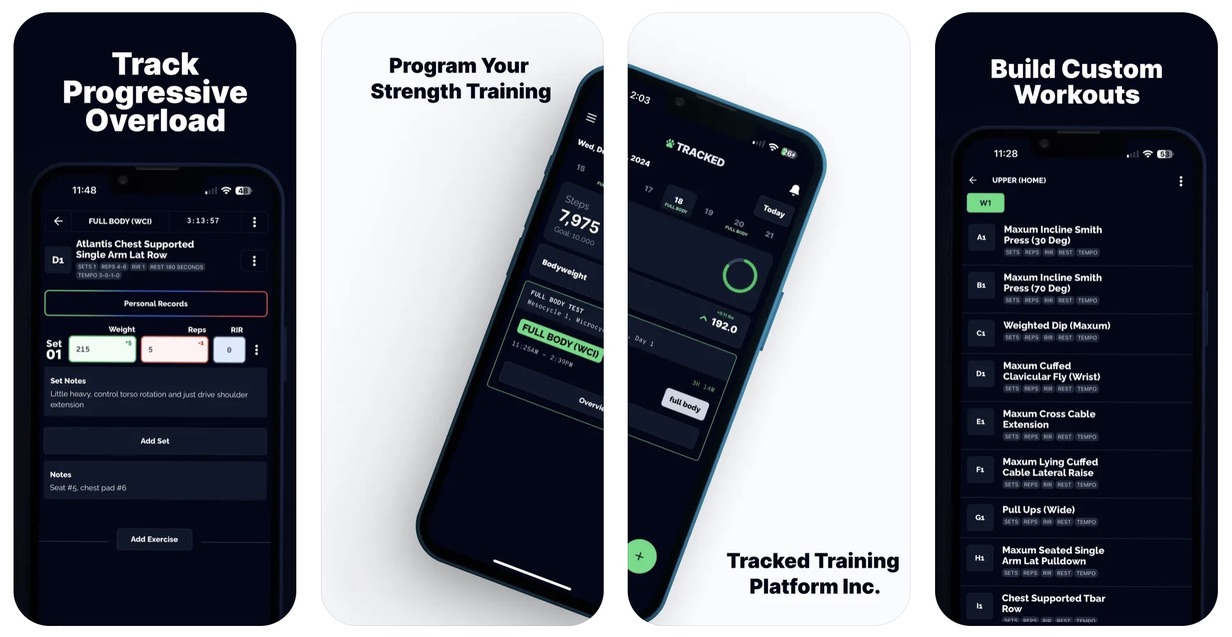
User testimonials reflect the functionality: for example, one review notes Tracked “allows so much [customization] like resistance profile, [and] tracking progressive overload is so easy and especially clear”. Community feedback also praises the app’s breadth of features without paywalls. These comments are borne out by the official site, which highlights professional adoption (“Used by professionals”) and has hundreds of enthusiastic user reviews. In short, Tracked rivals many paid apps in capability, despite costing nothing. Its design centers on accurate data and user control, aligning with strength training principles (progressive overload, precise logging). The chief limitation is platform maturity: Tracked's wearable integrations are still expanding, though the team has hinted at adding more on the roadmap. For serious lifters seeking a science-backed tracking solution without any subscription, Tracked stands out as one of the best options available.
Hevy – Social-First Free Tracker
Hevy is a popular cross-platform app (Android and iOS) known for a simple interface and built-in community. It offers a generous free tier, but its Pro upgrade is very affordable – about $3.99/month (often discounted to $2.99) or $23.99/year. The app’s exercise library includes roughly 350+ movements (bodyweight, free weight, machines) and it lets you create custom exercises. Hevy tracks sets, reps, weight, and also supports Rate of Perceived Exertion (RPE) on any set. Other professional features include progress graphs, one-rep-max (1RM) estimates, plate calculators, and measurement logging. In trials, the interface is very user-friendly, streamlining workout entry for busy gym-goers with great wearable support.
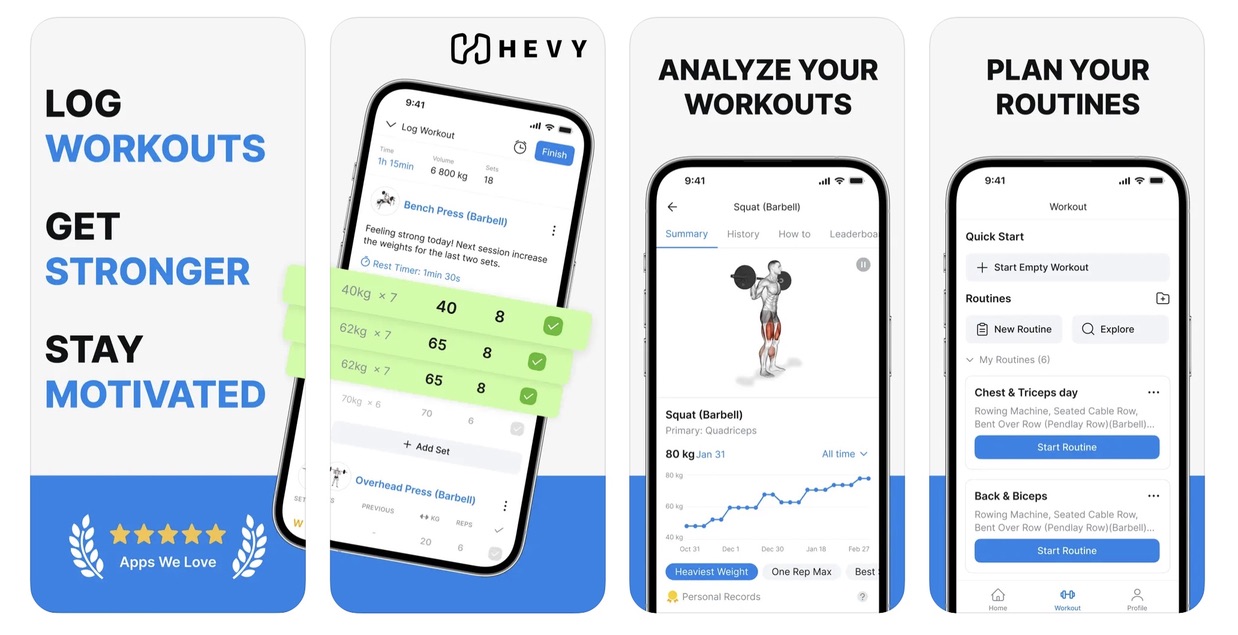
Where Hevy truly differentiates itself is community engagement. Users can follow friends, post workouts, like/comment on others' logs, and even clone public routines. This social approach is supported by research linking accountability to adherence. Hevy's developer team frequently updates the app and maintains a high App Store/Play rating (~4.9/5). The Pro subscription unlocks useful extras: unlimited routines, unlimited custom exercises (the free version caps these), and extended history review. Compared to competitors, Hevy's pricing is very low: for perspective, Strong's Watch-centric PRO is $29.99/yr and JEFIT Elite is $69.99/yr. A possible downside is that Hevy's programming tools are basic (no automated periodization) – it prioritizes social features which not all gym goers need. Overall, Hevy excels for those who want free core tracking plus a motivational community at minimal cost.
TrainHeroic – Coach-Driven Ecosystem
TrainHeroic operates on a coach-athlete model. Athletes can download the app for free, but full functionality typically comes through a coach-managed program. Coaches pay a subscription (starting at $9.99/month for one athlete, up to $399.99/month for large teams). The strength of TrainHeroic lies in its professional features. It has a large exercise library (1,500+ movements) with professional video demos. It also includes wellness monitoring: before each session, athletes complete readiness surveys (sleep, stress, muscle soreness, etc.), providing metrics for recovery and autoregulation. Communication is built-in – “TH Chat” allows instant messaging between coaches and athletes. The app offers a StackUp leaderboard so athletes can compare lifts globally. Coaches can buy or sell training programs via the TrainHeroic Marketplace, including niche protocols for powerlifting and Olympic lifting.
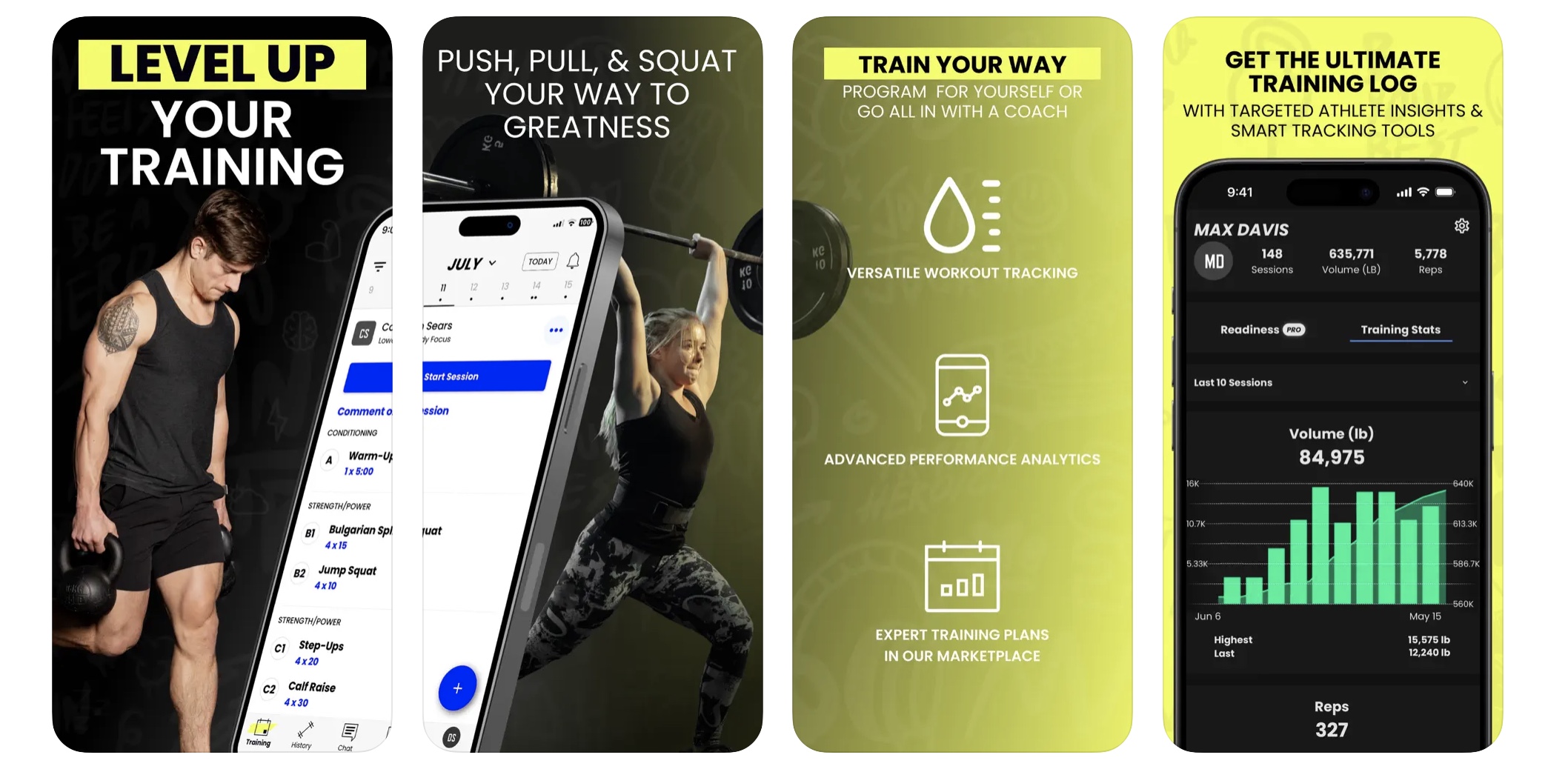
For evidence-based athletes, TrainHeroic supports detailed load tracking (total volume, 1RM history, reps in reserve) and configurable rest timers. However, because it is oriented toward coached scenarios, a lone user without a coach might find it cumbersome or lacking the tool depth for program analysis. Users have reported performance issues – lag, long load times, and occasional crashes – which can be frustrating given the high price point for coaches.
Strong – Simple, Apple Watch Integration Specialist
Strong is a mature gym log app available on iOS, Android, and notably Apple Watch. It boasts over 5 million users worldwide and a polished interface. Strong’s big advantage is real-time wearable support: you can navigate workouts entirely on the Apple Watch, thanks to its official watchOS app. Other core features include a database of many exercises, animated workout demos, adjustable rest timers, and comprehensive analytics (1RM charts, volume, etc.).
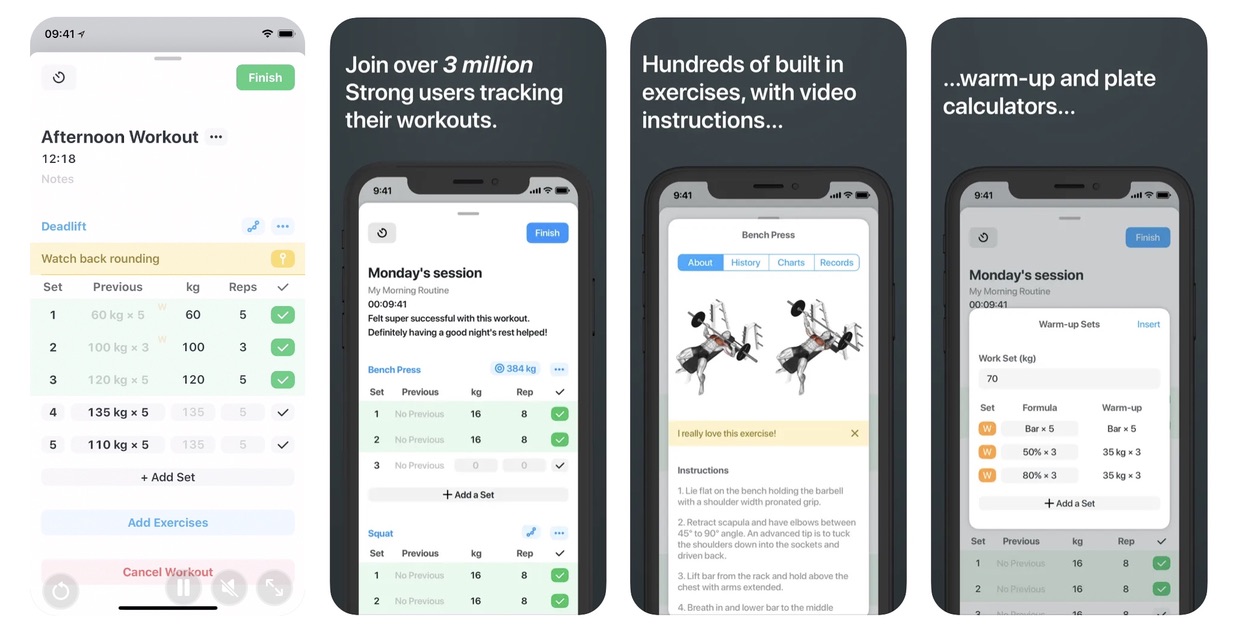
Strong’s business model centers on Strong PRO: $4.99/month or $29.99/year (with a $99 lifetime option) unlocks unlimited custom routines and basic stats. The free version lets you log unlimited workouts but limits you to only three custom routines (effectively forcing most serious users into Pro). In practice, many lifters use Strong’s free mode to track sessions but find the custom-program restriction too onerous. The app is well-reviewed, though some users report occasional sync or stability issues.
In summary, Strong is ideal if you prioritize seamless wearable integration (Apple Watch) and a simple UI, and don't mind paying for it. Its subscription is mid-range compared to others (cheaper than JEFIT Elite, higher than Hevy). Apple users especially like how Strong automatically logs sets on the watch and shows live data. For Android-only or budget lifters, Strong's watch features are not applicable, so more cost-efficient free apps may be preferable.
RP Hypertrophy – Science-Based Programming
RP Hypertrophy is a specialized app by Renaissance Periodization (coached by Dr. Mike Israetel). It is very expensive ($299.99/year or ~$35/month) and is accessed via web browser (no dedicated iOS/Android app). The key idea is advanced autoregulation: after you input your current program or select from 45+ predefined templates (body-part specialization, powerbuilding, etc.), the app guides you through each week’s training, adjusting volume based on your feedback (muscle pump, soreness, performance). It also includes 250+ instructional videos by RP coaches and tracks things like RPE and reps in reserve to implement MEV/MRV concepts.
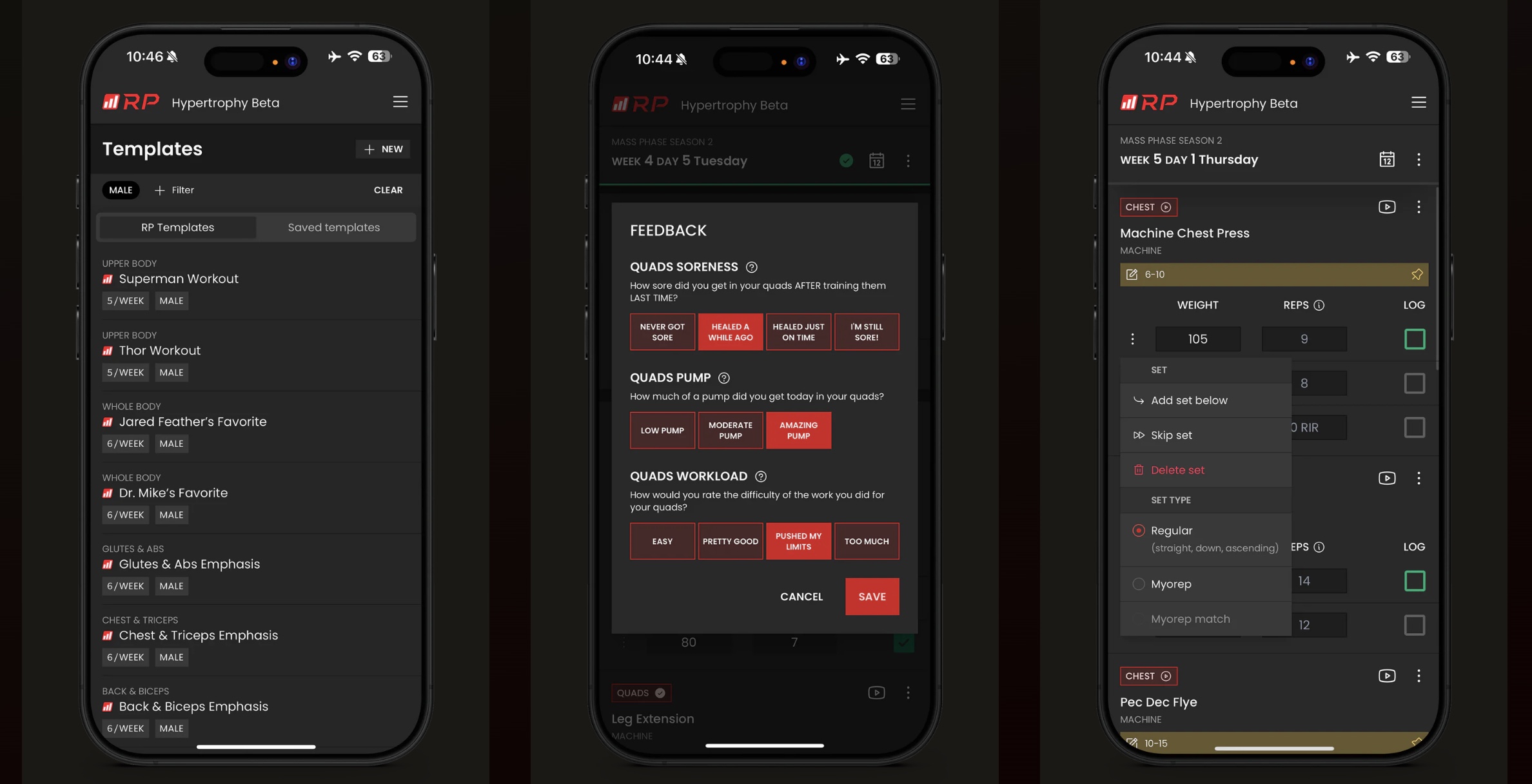
In effect, RP Hypertrophy applies Israetel's periodization model: it ensures you do neither too little nor too much, using your logged results to modulate sets/reps each mesocycle. This can be very useful for bodybuilders who want volume management. However, the learning curve is steep – users must understand periodization theory – and the app offers no novice guidance or automated exercise selection beyond its templates. It also lacks basic features like rest timers or offline use which is critical while tracking in the gym. In reviews, experts note that aside from the methodology, the app's functionality is fairly bare and the high cost is hard to justify for most users. In summary, RP Hypertrophy offers a unique, data-driven approach for lifters focused on hypertrophy, but its utility is limited by price, complexity, and internet-only access.
JEFIT – Comprehensive Database with Community
JEFIT is one of the oldest and largest strength-tracking platforms. It features a vast exercise database (now ~1,400+ exercises) with animations and detailed filters. Over 9–10 million users use JEFIT worldwide. The app includes most standard features: rest timers, plate/percent calculators, built-in charts (progress maps, PR records), heat maps of muscle usage, and thousands of pre-built routines for all goals (powerlifting, bodybuilding, general fitness). It also has an online community with challenges and social feed.
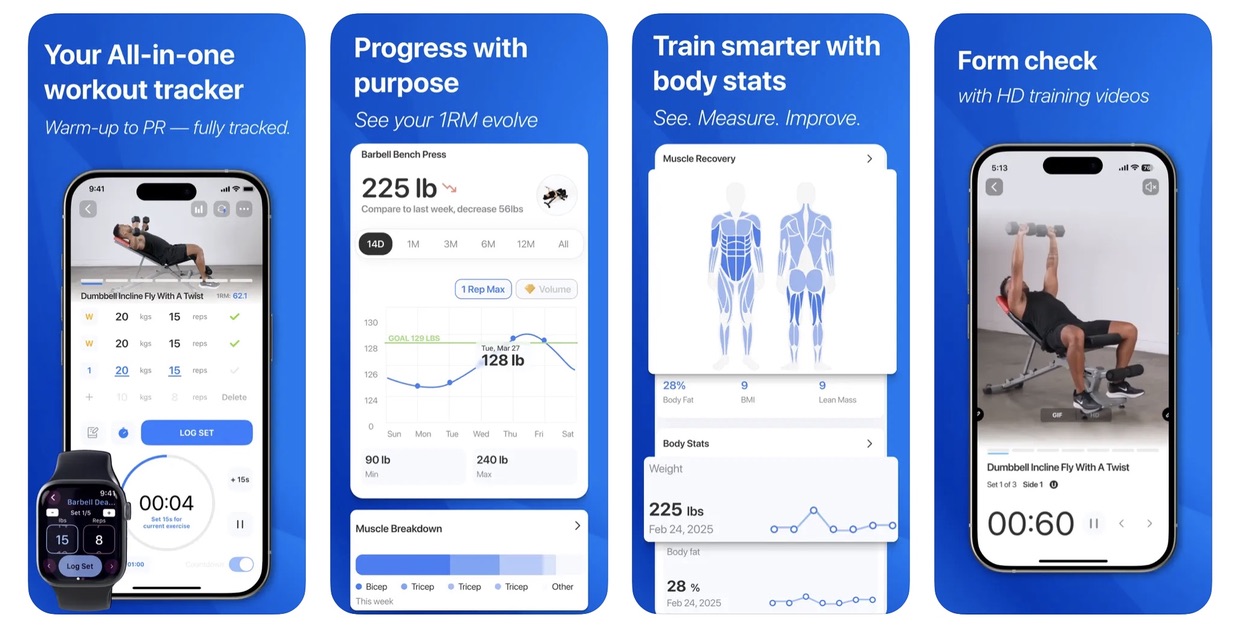
Pricing: JEFIT is free to use (ad-supported) for logging and libraries. An Elite subscription removes ads and adds premium workout plans and analytics. Elite costs about $12.99/month or $69.99/year. For most users, the free version is ample – it allows unlimited workouts and access to the full exercise library. Serious users may prefer Elite to unlock workout templates from pro coaches and extra metrics. In practice, JEFIT's strength is it accommodates beginners. New lifters benefit from the guidance and demos. The main limitations are the generic feel (lack of programmed progression) and UI clutter. Overall, JEFIT is a robust all-purpose tracker – not as specialized as Strong or RP, but highly versatile and with community features that some lifters value.
Fitbod – AI-Generated Workouts
Fitbod markets itself as an AI-powered personal trainer. Users enter profile (goals, experience, equipment) and the app algorithm generates workouts from its exercise library (over 1,000 exercises). Fitbod then adapts future sessions based on how you logged reps/recovery: it uses a "muscle recovery" heatmap to show which muscle groups are still fatigued. The interface has form videos and a slick UI.
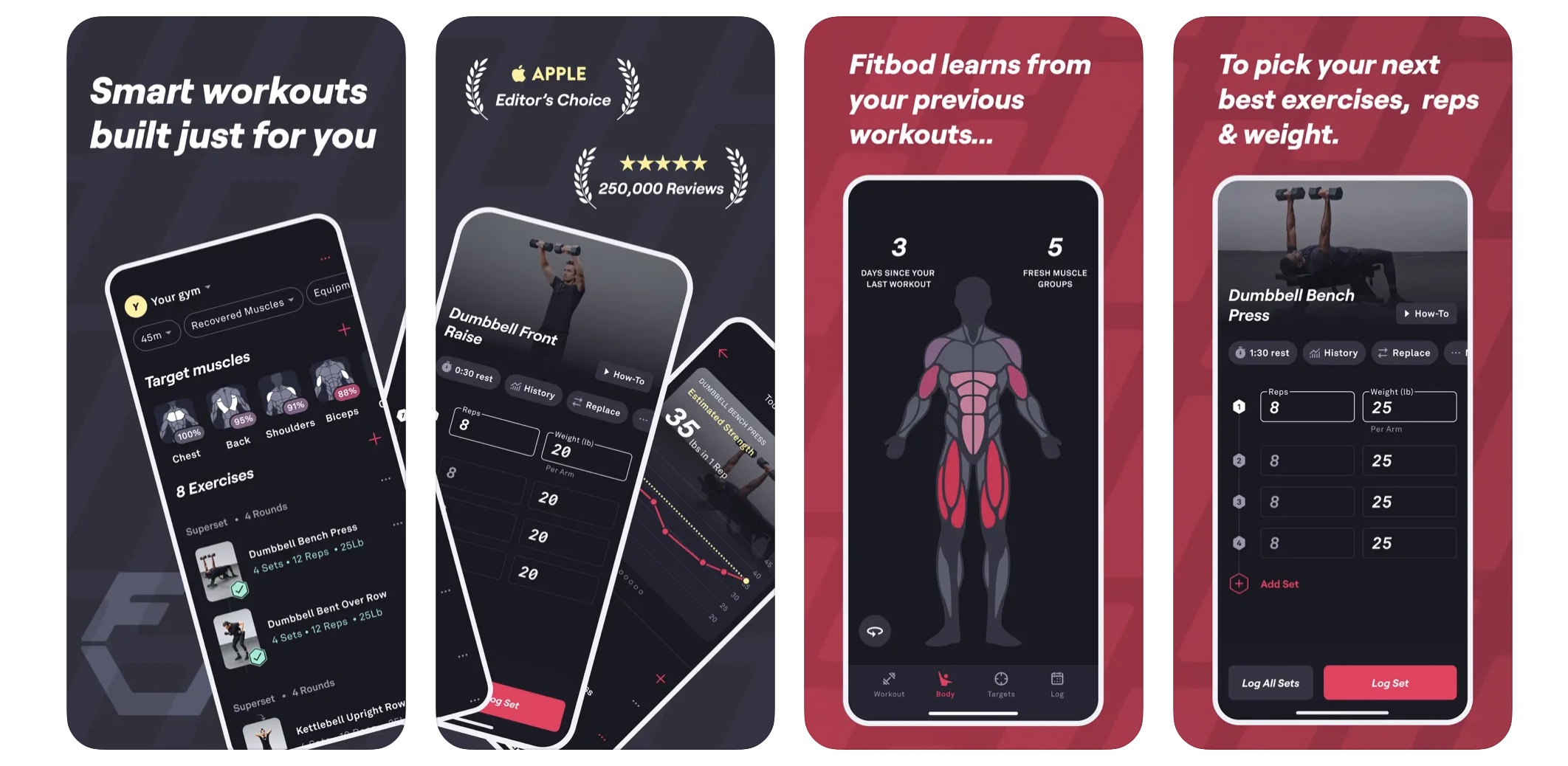
However, expert reviews have been mixed. The subscription is $15.99/month (or $95.99/year). Reviewers note that while Fitbod's UI is nice, the AI itself often produces repetitive or suboptimal routines. Dr. Muscle found that "Fitbod's AI has limitations… workouts feel randomized rather than strategically tailored". In practice, beginners may enjoy the convenience early on, but experienced lifters often find they need to tweak the routines heavily. Fitbod's value proposition is clearest for intermediates wanting occasional guidance or for travelers changing equipment; advanced trainees usually outgrow it. Because many of Fitbod's core features (exercise library, data tracking) can be found in free apps, paying for Fitbod mainly buys convenience rather than fundamentally better results.
RepCount – Focused Strength Log
RepCount is a straightforward gym log aimed at serious lifters. It has been around for years and has over 1 million downloads on iOS/Android. The core app is entirely free (no ads) and supports unlimited workouts, programs, and custom exercises. Its interface is intentionally minimalist and fast, minimizing distractions during training.
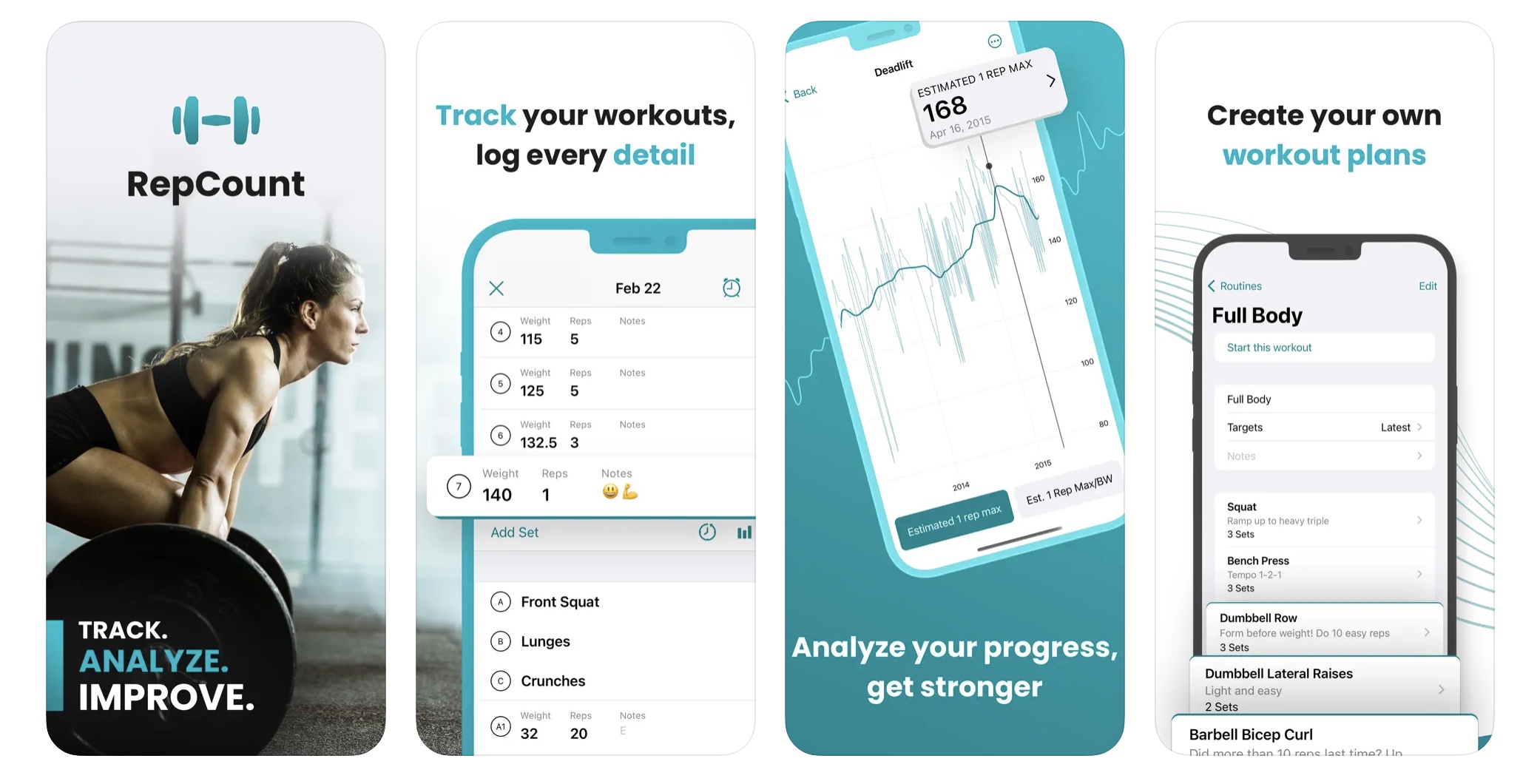
For analysis, RepCount offers premium features via a modest subscription (about $3.99 one-time or monthly). Premium adds hardware-accelerated charts (volume over time, calculated 1RM, highest weight, etc.), rep-record tables, and superset/drop-set support. Importantly, there is no AI or automated programming – users plan their own routines fully. This appeals to bodybuilders and powerlifters who design their own programs and just need a reliable logbook. The app tracks progress thoroughly (PRs, 1RM graphs, total volume), which aligns with best practices for progressive overload. User feedback consistently praises RepCount for stability and utility: one reviewer calls it "by far the best app I have ever used for tracking my workouts" and commends its simplicity. In summary, RepCount's strength is reliability and clarity for strength training. If you already know what to do and just want a no-frills tracker (with affordable optional stats), RepCount is a top pick.
Key Features for Serious Lifters
Progressive Overload Tracking: The ability to monitor and quantify progression is critical. Tracked’s “green-lit” system and RepCount’s detailed volume charts exemplify this. Most apps compute 1RM and show trends, but Tracked and RepCount adjust records for bodyweight and emphasize RIR/RPE, aligning with training science. Fitbod and RP both use feedback to autoregulate volume, but Tracked and RepCount give lifters full control without assumptions.
Exercise Libraries and Customization: JEFIT and Hevy offer large predefined libraries (1,400 and ~350+ exercises) and allow creating custom movements. However, many serious lifters prefer creating their own exercises anyway – so an unlimited custom exercise feature (available in Tracked, Hevy and RepCount) is more important than having every possible demo on hand.
Rest Timers and Timed Sets: Automatic timers help keep intensity. Strong and JEFIT provide auto-rest timers by default; TrainHeroic adds smart timers. Surprisingly, RP Hypertrophy and Fitbod do not integrate rest-timer functions, assuming users will handle that separately. Users citing best-practice apps often highlight the convenience of built-in timers (e.g. Hevy, Strong, RepCount, Tracked) during dense workouts.
Data and Analytics: Free apps differ in analytics depth. JEFIT and RepCount offer charts (volume history, PR tables) for free or cheap. Hevy Pro adds body measurements tracking. RP Hypertrophy’s claim to uniqueness is its autoregulation algorithm (based on the IR recommended volume theory). In general, high-end paid apps like RP or Fitbod promise science-based adjustments, but reviews find those algorithms underdeliver for experienced users. Empirically, consistent volume tracking and manual RPE logging (as found in Tracked, Hevy, RepCount) suffice for most trainees.
Community and Social: Some lifters are motivated by community. Hevy builds a social network of “gym friends,” and Liftoff (GymBros) gamifies competition. Such features can boost adherence but may not benefit those who train privately. RepCount and Tracked deliberately omit social feeds, focusing purely on data. The research suggests social support can aid motivation, so apps like Hevy fill that role. But advanced lifters often prefer direct performance feedback over social aspects.
Automatic Programming vs Manual Control: There’s a spectrum. Fitbod and RP Hypertrophy attempt to auto-generate or adjust programs; TrainHeroic provides coach-led plans; others expect manual routine creation. Scientific consensus values individualized programs, so many serious athletes prefer full control. This favors apps like Tracked, Hevy, Strong, and RepCount, where the user’s own periodization is logged rather than overridden by an AI.
Choosing the Right App
- Tracked.gg is unmatched as a free, feature-rich tracker. RepCount ($3.99) can serve Android or iOS users who want simple strength logging without subscriptions.
- For iOS users: Hevy provides the closest equivalent to Tracked’s features and is very inexpensive. Strong is ideal if you use an Apple Watch and want a polished ecosystem. RepCount is also available on iOS for core logging needs.
- For powerlifting/bodybuilding: Prioritize apps that respect serious training. Tracked.gg and RepCount have comprehensive logging and volume tracking, which most athletes prefer. RP Hypertrophy may benefit dedicated bodybuilders seeking periodization automation, but its complexity and cost limit broad appeal.
- For hypertrophy or general fitness with guidance: If you want some program structure, Hevy’s paid tier or Fitbod might help beginners/intermediates (Fitbod’s AI is better than nothing for novice programs). For science-oriented hypertrophy, RP Hypertrophy is unique but is best seen as supplementary (it enforces autoregulation via RPE and pump).
- For cross-platform social motivation: Hevy is a top pick for both Android and iOS, with a low-cost Pro tier. Lifters who value community features may also try Liftoff (GymBros), though it’s less focused on hardcore tracking.
Conclusion
In summary, free and low-cost tracking apps often outperform expensive ones in terms of practical utility for serious lifters. Across the board, progressive overload monitoring, customizable workouts, and reliable data are more important than flashy AI or video libraries. Tracked exemplifies this principle: it offers nearly every advanced tracking feature (RPE/RIR logging, unlimited custom exercises, detailed analytics) for free, effectively “beating” many paid competitors. This aligns with user reports that its free tier is “infinitely better” than paid apps.
Therefore, our analysis strongly favors Tracked as the best overall tool for strength training in 2026. These apps respect lifter expertise without imposing unnecessary guidance or subscriptions. However, the optimal choice still depends on individual needs: Apple Watch users may prioritize Strong, and those craving community may prefer Hevy. The key takeaway is that data consistency and progressive overload matter most – and these can be achieved just as well (or better) with well-designed free apps as with costly alternatives. As evidence shows, an app’s price tag does not guarantee superior programming or results. Serious trainees should focus on matching an app’s features to their training style — and can start by running their numbers through Tracked's pricing and one-rep max calculator — rather than assuming more expensive or more downloads means better.